
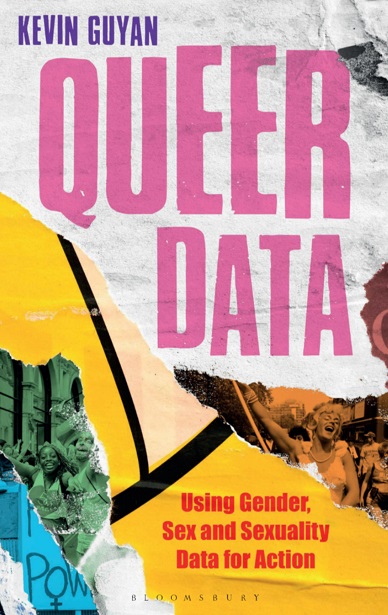
Queer Data by Kevin Guyan explores the relationship among data, identity, and power, particularly as it relates to LGBTQ communities. The book argues that data is never neutral; the ways people are categorized, counted, and analyzed shape how they are understood, included, or excluded in society. The book shows that collecting data on LGBTQ communities can have important benefits, including making inequalities visible, improving services, supporting political action, and strengthening recognition and rights. However, at the same time, it also highlights the risks of data collection. To be counted, people are often forced to fit into fixed categories that may oversimplify identities or exclude experiences that do not fit neatly within existing classifications.
The book includes three parts: (1) The first part examines the history of collecting data about LGBTQ people through surveys, interviews, and censuses; (2) The second part focuses on how data analysis, algorithms, and rigid classifications can erase or distort LGBTQ experiences; and (3) The third part turns to questions of power, asking whose voices matter in discussions about data and how data can be used for activism and social change.
Part 1: Collecting Queer Data
Gaps and Absences: A History of Queer Data
The first part of Queer Data looks at the history of collecting data about LGBTQ people and shows that this history is full of gaps, biases, and unequal power relations. Kevin Guyan explains that many LGBTQ experiences were never recorded, while the data that did exist was often collected by governments, doctors, or researchers who viewed LGBTQ people as deviant or problematic. Historical categories and methods reflected the values of their time, meaning that data was never neutral.
The book also shows how data has had mixed effects over time. In the mid-20th century, surveys and studies about homosexuality helped support legal reforms and greater visibility for some LGBTQ people. But these same systems also created stricter categories and new forms of control, often benefiting only certain groups while excluding others. Later, LGBTQ activists used data to push for rights and recognition, while queer theorists questioned whether fixed identity categories could ever fully represent people’s lives and experiences.
More recently, the internet and equality policies expanded the collection of LGBTQ data through online platforms, diversity forms, and censuses. This has helped increase visibility and support some legal and social changes. At the same time, the book warns that data collection can become more about compliance, control, or institutional image than real change. The history of queer data shows that who gets counted, how they are counted, and why they are counted are always political questions shaped by power.
Moving Targets: Queer Collection Methods
This chapter argues that data collection methods like surveys, interviews, and forms are not neutral. They do not simply record reality; they also shape how people understand themselves and how society understands identities like gender and sexuality. The author shows that even small decisions about categories, labels, or questions can influence the data that is produced and the stories that become visible.
The chapter also explains that identities are not fixed or stable. People’s understanding of their gender or sexuality can change over time and across different contexts, but many data systems still treat identity as something simple and permanent. A queer approach, therefore, questions rigid categories and asks whose interests data collection really serves. It also highlights that research is relational: both participants and researchers influence the process, and data collection itself can become emotional, transformative, and political.
At the same time, the chapter raises important ethical concerns. Organizations often focus on producing “good” or measurable data rather than addressing the real problems behind the numbers. LGBTQ people may repeatedly share personal experiences without seeing meaningful change. Still, the chapter argues that recording experiences and reporting problems matter because turning experiences into data can prompt institutions to acknowledge issues that would otherwise remain invisible.
Queer the Census: Sex, Sexual Orientation and Trans Questions in Scotland's Census
This chapter explores how LGBTQ questions were added to Scotland’s census and why this matters. A census is often presented as a neutral way of counting the population, but the book argues that it also shapes how identities are recognized and understood. Including questions about sexual orientation and trans identity increased LGBTQ visibility and recognition, but it also raised difficult questions about who gets counted, how categories are defined, and who may still be left out.
The chapter shows that even simple census questions involve political and social struggles. Debates around the sex question, sexual orientation question, and trans question revealed tensions between self-identification, legal definitions, and fixed categories. Some changes made the census more inclusive, such as adding write-in options or allowing people to answer based on their identity, but many LGBTQ experiences still do not fit neatly into official categories. In this way, data collection can both recognize and simplify people’s identities at the same time.
The chapter also highlights the tension around participation. Being counted can help make inequalities visible, improve services, and support political change. But it can also increase state control or force people into categories that do not fully represent them.
Beyond Borders: Queer Data Around the World
This chapter looks at how different countries collect data about gender, sex, and sexuality, and shows that these practices are shaped by politics, culture, language, and power. Governments use data to define and manage populations, but the categories they create always include some people while excluding others. Around the world, approaches differ widely: some countries collect detailed LGBTQ data, while others avoid or even block it entirely.
The chapter also shows that language and administrative systems strongly affect how identities are recognized. Many official systems still rely on fixed categories like “male” and “female”, which can exclude trans, non-binary, and intersex people. Some countries have tried adding third-gender categories or more inclusive approaches, while others have reduced the collection of gender data when it is not necessary. These changes can improve visibility and recognition, but they can also create new problems if systems, census workers, or institutions are not prepared to support them properly.
Through examples from countries such as the US, Nepal, India, Canada, and New Zealand, the chapter shows that LGBTQ data can help support rights, expose violence, and strengthen activism. At the same time, data can simplify identities, erase some experiences, or reinforce existing inequalities.
Part 2: Analyzing Queer Data
Straightwashing: The Cleaning and Analysis of Queer Data
This chapter focuses on what happens after data is collected. It argues that data analysis is not neutral. The way data is cleaned, grouped, and interpreted shapes the stories that institutions tell about LGBTQ people. During analysis, identities that do not fit expected categories are often simplified, changed, or erased. The chapter calls this process “straightwashing”, which means forcing data to fit heterosexual and binary norms.
The chapter also discusses the problem of “small numbers”. Because LGBTQ populations are often treated as statistically small, institutions sometimes use this as a reason not to collect data or avoid taking action. At the same time, grouping many different identities together can hide important differences and inequalities within LGBTQ communities. It argues that open-text responses and more flexible methods can help people describe themselves more accurately instead of forcing them into rigid categories.
Finally, the chapter critiques the growing reliance on big data and algorithms. Large datasets are often presented as objective, but they still reflect social biases and existing power structures. LGBTQ experiences are often too complex to fit neatly into automated systems. It argues that smaller, more careful forms of research can sometimes yield deeper, more meaningful insights.
Queer Validation: Data Practices and the Recognition of LGBTQ Identity Claims
This chapter explores how LGBTQ identities become recognized, questioned, or rejected through data systems. It shows that identity is not simply recorded by data; it is validated through social and institutional power. Debates around trans self-identification in the UK reveal this clearly. While many LGBTQ people understand their own identities, institutions and public systems often decide whether those identities are considered “real” or acceptable.
The chapter compares different ways identities are validated. Some systems rely on self-identification, where people define themselves. Others depend on external judgment, where researchers, governments, or experts decide who belongs to a category. It shows how this can become harmful, especially when institutions require people to “prove” their identity through documents, medical processes, or stereotypes. People whose identities do not fit dominant expectations are often questioned or excluded.
The chapter also examines biometric and behavioral technologies, such as facial recognition, voice recognition, and online tracking systems. These technologies often present themselves as objective, but they are built on biased assumptions about gender, sexuality, race, and “normal” bodies. As a result, LGBTQ people, especially trans and non-binary people, are more likely to be misrecognized or treated as suspicious.
Part 3: Using Queer Data
Loud Coices: Communicating Queer Data in Online Spaces
This chapter looks at who gets to speak about LGBTQ data and whose voices are treated as important. It reflects on online debates around trans inclusion in Scotland’s census and the hostility that often surrounds these discussions. It argues that conversations about queer data are not just technical debates about surveys or categories; they are also struggles over power, recognition, and whose experiences are believed.
The chapter introduces the idea of “queer data competence”, meaning that people making decisions about LGBTQ data should understand LGBTQ lives, inequalities, and the limits of their own knowledge. It argues that many important decisions are still made by people with little understanding of the communities affected. It stresses that LGBTQ people should be meaningfully involved in decisions about data that shapes their lives, while also recognizing that repeatedly asking marginalized people to educate institutions can become exhausting.
The chapter also explores the complicated relationship between researchers and the communities they study. Being an “insider” or “outsider” is not simple because identities overlap in many ways. It argues that researchers and institutions must reflect on their own privilege and how they may benefit from unequal systems.
Fight Back! Using Queer Data for Action
This chapter explores how queer data can be used for social and political change. Through conversations with queer and trans researchers, it shows that data can help make LGBTQ people more visible, improve services, support funding, and strengthen political recognition. For example, data about trans and non-binary communities can help governments better understand healthcare needs. At the same time, visibility is not always safe or enough on its own. Being counted can also expose marginalized people to control, backlash, or exclusion.
The chapter also warns that data does not automatically create justice. Sometimes institutions collect reports, statistics, and diversity plans without making meaningful changes. LGBTQ communities are often forced to repeatedly prove their oppression with data before people in power take action. Undercounting in surveys and censuses can make inequalities appear smaller than they really are, which can weaken political support and funding. The chapter argues that data can either challenge inequality or help maintain the status quo, depending on how it is used.
Finally, the chapter discusses different ways of responding to harmful data systems: participation, reform, and abolition. Some people choose to participate in existing systems to gain visibility and resources. Others try to reform systems to make them fairer and more inclusive. Others argue that some systems are so unequal that they should be replaced completely.