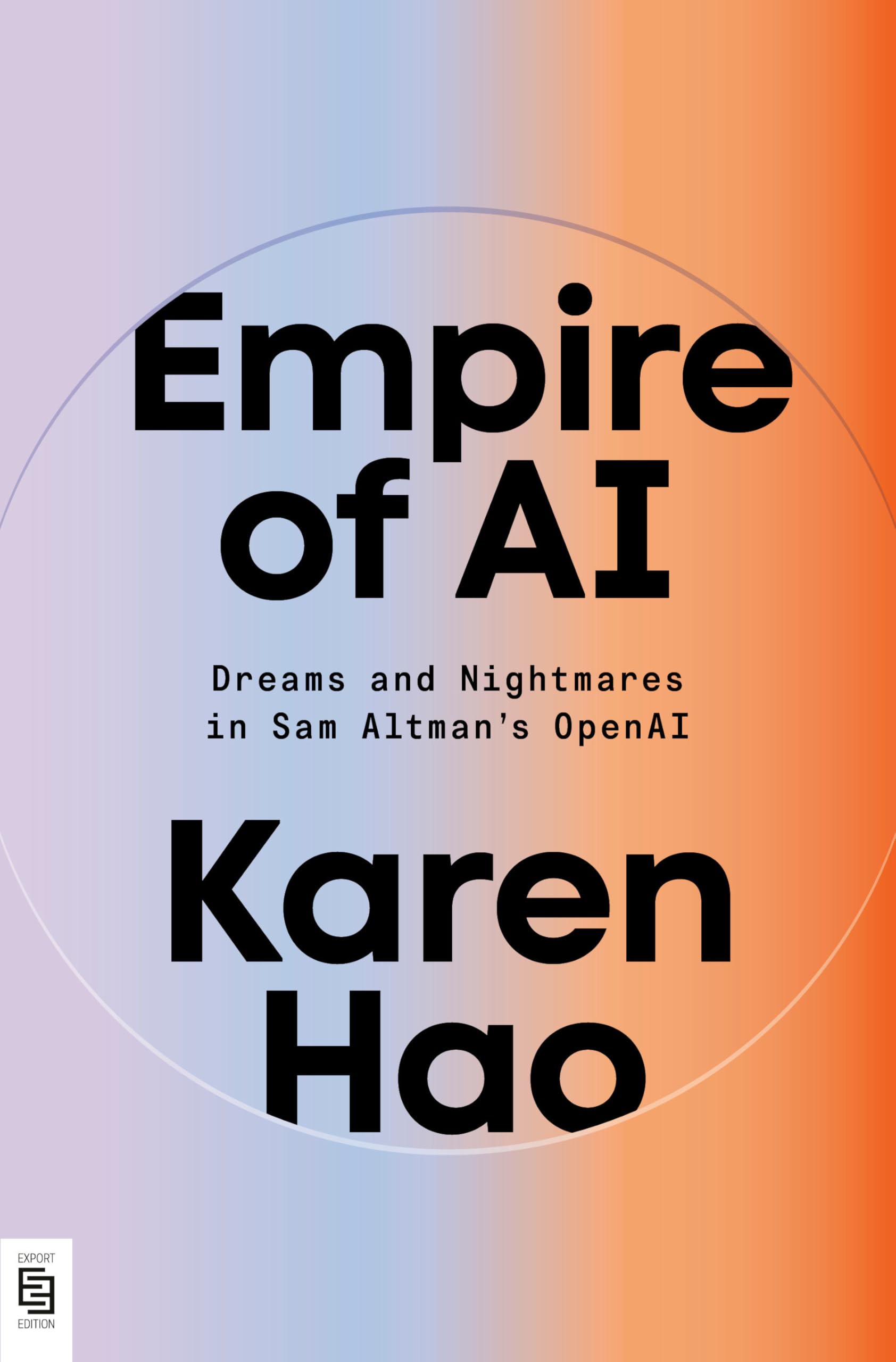
Empire of AI by Karen Hao is a book about the story of OpenAI and the development of ChatGPT. Through the history of OpenAI, Hao explores the ambitions, conflicts, and decisions that shaped the company, while examining the broader race to build AI and its human, environmental, and political consequences. The book is divided into four parts. Part I introduces the founders of OpenAI and the early vision behind the company. Part II follows its transformation from a nonprofit research lab into a commercial AI company competing to build ever larger models. Part III examines the hidden human, environmental, and social costs of AI. And, Part IV focuses on the growing concentration of power in the AI industry and what it means for the future of AI and society.
Part 1
Divine Right
OpenAI began with a shared concern about the future of AI. Elon Musk believed advanced AI could become dangerous if it was controlled by a few large companies, especially Google. Sam Altman shared these concerns and proposed creating a nonprofit organization that would develop AI safely for the benefit of humanity. In 2015, Musk, Altman, Greg Brockman, Ilya Sutskever, Dario Amodei, and others founded OpenAI. Over time, however, Musk and Altman's relationship broke down. Musk came to believe that Altman had used his support to build his own influence, and the two eventually became rivals with different views on AI and OpenAI's future.
The chapter also explores Sam Altman's personal background and rise in Silicon Valley. Growing up in St. Louis, he showed an early talent for programming, curiosity, and ambition. After leaving Stanford, he founded the startup Loopt, which was not a major success but helped him build valuable connections. Altman's greatest strengths were not technical research but his ability to inspire people, raise money, build networks, and persuade others to support ambitious ideas. As president of Y Combinator, he became one of the most influential figures in the startup world, shaped by mentors such as Paul Graham and Peter Thiel, who encouraged him to think big and build powerful companies.
The author presents Altman as a complex and controversial leader. Many colleagues admired his intelligence, generosity, and ability to bring talented people together, while others described him as highly strategic, manipulative, and sometimes dishonest. The chapter also discusses public accusations made by his sister Annie, which Altman and his family strongly deny. Overall, the chapter argues that the story of OpenAI is not only about advances in AI but also about the personalities, ambitions, relationships, and power struggles among a small group of influential people whose decisions could shape the future of AI.
A Civilizing Mission
This chapter explains how OpenAI changed from a nonprofit research lab into a company that needed billions of dollars to pursue artificial general intelligence (AGI). Greg Brockman built the organization and recruited leading researchers such as Ilya Sutskever, while the team worked toward creating AI that could match or surpass human intelligence. They believed AGI could arrive much sooner than most experts expected and attracted top researchers by promoting a mission to benefit humanity rather than offering the highest salaries. However, as competition with companies like Google increased, they realized that building more powerful AI required enormous computing resources and funding.
As OpenAI grew, it became clear that a nonprofit could not afford the cost of developing cutting-edge AI. This led to disagreements among the founders, especially between Elon Musk and Sam Altman, over the company's future and leadership. Musk eventually left OpenAI in 2018, and Altman took charge. Under his leadership, OpenAI created a new "capped-profit" structure that allowed it to raise investment while claiming to keep its mission above financial interests. At the same time, the company demonstrated impressive AI systems, such as its Dota 2 player and increasingly capable language models, helping convince Microsoft to invest $1 billion in 2019.
The chapter also highlights an important debate about AI safety. Some researchers, including Dario Amodei, focused on the long-term risk that superintelligent AI could threaten humanity, while others, such as Timnit Gebru and Deborah Raji, argued that AI was already causing serious problems through bias, surveillance, misinformation, and environmental harm. The chapter suggests that OpenAI increasingly emphasized future existential risks while paying less attention to these immediate social issues. Overall, it argues that OpenAI's need for massive funding gradually shifted the organization away from its original nonprofit ideals toward a more commercial model.
Nerve Center
This chapter describes how OpenAI changed after Microsoft's $1 billion investment in 2019. The company was no longer just an idealistic nonprofit research lab; it was becoming a powerful organization with a more commercial and secretive culture. During a visit to OpenAI's San Francisco office, the author notices the contrast between the modern, comfortable workplace and the surrounding city. By then, OpenAI had limited the release of GPT-2, adopted a capped-profit structure, and partnered with Microsoft, leading many people to question whether it was moving away from its original mission.
In interviews, Greg Brockman and Ilya Sutskever argue that AGI could help solve major global problems such as disease, climate change, and scientific discovery. They believe building AGI is inevitable and that OpenAI should develop it before others do. However, they cannot clearly explain what AGI will look like or exactly how it will improve society. When asked about the environmental cost of training large AI models, they argue that AGI will eventually help solve those problems, a claim the author views as an uncertain bet on future benefits.
The chapter also shows how OpenAI became increasingly secretive despite its public commitment to openness. Employees were cautious about what they shared, access inside the company was tightly controlled, and staff were later warned not to speak with the journalist. Brockman insists that the partnership with Microsoft and the new company structure have not changed OpenAI's mission, but the author argues that staying ahead of competitors had become the company's highest priority. This focus on winning justified raising huge amounts of money, building larger AI systems, and becoming less transparent. The chapter ends with the publication of the author's critical MIT Technology Review article, after which OpenAI stopped communicating with the author for the next three years.
Dreams of Modernity
This chapter argues that technology is not automatically good for everyone. Throughout history, new technologies have often benefited powerful people while shifting many of the costs onto weaker groups. The author argues that AI follows the same pattern. Although it is presented as a technology that will improve society, its hidden costs, including environmental damage, worker exploitation, surveillance, and growing inequality, are often borne by vulnerable communities. The chapter also explains that the term "artificial intelligence" helped attract attention and investment, while unclear definitions of intelligence have allowed the field to keep moving its goals from AI to AGI.
The chapter traces the development of AI from early rule-based systems to today's deep learning models. As computing power and internet data grew, deep learning became the dominant approach, largely because it produced commercially valuable results. This shifted AI research from universities to large technology companies, which now control much of the funding, data, and computing resources. The author argues that this has encouraged surveillance capitalism and "data colonialism", where companies collect massive amounts of personal data, often without meaningful consent, and concentrate the benefits while people around the world bear the costs.
Finally, the chapter discusses both the strengths and limitations of modern AI. Deep learning systems are very good at finding patterns, but they do not truly understand the world. As a result, they can produce biased, unreliable, or false outputs, including the hallucinations seen in systems like ChatGPT. While generative AI can improve productivity and create real value, its benefits are distributed unevenly, and many people pay the price through lost privacy, job displacement, environmental costs, and exploitation of their work. The author concludes that the AI industry has become overly focused on building ever-larger models, even though this is a strategic choice rather than the only possible path for the future of AI.
Scale of Ambition
This chapter explains how OpenAI came to believe that simply making AI models larger, with more data, computing power, and parameters, was the fastest path to AGI. Ilya Sutskever was the strongest supporter of this idea, arguing that researchers did not need entirely new methods, only bigger neural networks. This vision gained momentum after the invention of the Transformer architecture, which led to GPT-1 and later GPT-2. At the same time, Dario Amodei's team developed Reinforcement Learning from Human Feedback (RLHF) and discovered the "scaling laws", showing that AI performance improved predictably as models, data, and compute grew. These discoveries convinced OpenAI to make scaling its central strategy.
As OpenAI built larger models, GPT-2 demonstrated impressive language abilities but also generated harmful and misleading content. The company delayed releasing the full model, claiming it could be misused, although many researchers argued this decision was more about publicity than safety. GPT-2 also shifted OpenAI's research priorities away from robotics and games toward language models, based on the belief that language alone might be enough to achieve AGI. This strategy depended on the assumption that AGI was inevitable, so OpenAI believed it had to develop it first in order to make it safe.
The chapter ends by describing the enormous effort required to build GPT-3. Training such a massive model required Microsoft's supercomputer, huge amounts of internet data, and major engineering advances. OpenAI expanded its training data to include books, websites, code, and other online content, leading to later copyright lawsuits and concerns about data collection without consent. As the datasets grew, so did problems with bias and harmful content, forcing companies to rely on thousands of low-paid human workers to filter data and improve model behavior through RLHF. The author argues that OpenAI's decision to prioritize scaling transformed the entire AI industry, increasing competition, concentrating power in a few large companies, and raising ethical, environmental, and social concerns.
Part 2
Ascension
This chapter explains how Sam Altman transformed OpenAI from a research lab into a company focused on leading the global AI race. Drawing on his experience at Y Combinator, Altman believed AI would be a winner-takes-all industry, where the top company would shape the future. He set ambitious goals for OpenAI: produce the best research, secure the most computing power, raise the most funding, and lead in AI safety. To achieve this, he strengthened OpenAI's partnership with Microsoft, emphasized commercial success to fund future research, and argued that the company should become more secretive as its AI systems grew more powerful.
As OpenAI expanded, internal divisions became more pronounced. Researchers focused on advancing AI capabilities, AI safety specialists worried about long-term risks, and product teams pushed to turn GPT-3 into commercial services. Dario Amodei and other safety researchers became increasingly concerned that OpenAI was moving too quickly and that important decisions were often made before meaningful discussion. Meanwhile, OpenAI tightened security, treated its models as highly confidential, and shifted its strategy toward releasing AI through an API instead of openly sharing its technology.
The release of GPT-3 in 2020 established OpenAI as one of the world's leading AI companies. Its impressive ability to write text, generate code, and perform many tasks attracted developers, new talent, and additional investment from Microsoft. Internally, however, disagreements intensified as the company increasingly prioritized commercial growth over other research directions. Robotics projects were abandoned, GPT models became the central focus, and several senior researchers, including Dario and Daniela Amodei, left to found Anthropic. The chapter concludes by noting that although Anthropic presented itself as a safety-first alternative, it eventually adopted many of the same strategies as OpenAI, including building larger models, increasing secrecy, and competing aggressively at the frontier of AI development.
Science in Captivity
This chapter describes how GPT-3 changed the AI industry by showing that very LLMs could perform a wide range of tasks. Although GPT-3 did not create the same excitement as ChatGPT later would, it convinced many companies that scaling language models was a promising direction. At the same time, researchers became increasingly concerned about the enormous computing power and energy required to train these models, raising questions about their environmental impact.
The chapter focuses on Timnit Gebru and her work on AI ethics. Gebru had already shown that AI systems could be biased against women and people with darker skin, and she worried that LLMs trained on internet data would reproduce harmful stereotypes and misinformation. Together with Emily Bender and other researchers, she coauthored the influential "Stochastic Parrots" paper, arguing that LLMs consume huge amounts of energy, inherit harmful biases, rely on opaque training data, and appear to understand language even though they only predict likely words. When Google tried to stop the paper from being published, Gebru refused to withdraw it and was dismissed from the company, sparking widespread criticism from researchers around the world.
The chapter concludes that the conflict over the "Stochastic Parrots" paper reflected a broader problem: the growing lack of transparency in AI research. As companies such as OpenAI, Google, and Anthropic became more secretive, they shared less information about their models, training data, and evaluation methods. This made it increasingly difficult for independent researchers to verify company claims or assess the real capabilities, limitations, and risks of modern AI.
Dawn of Commerce
This chapter explains how OpenAI shifted from being mainly a research lab to becoming a fast-growing AI company. By 2021, the company was fully committed to the idea that larger models, more data, and more computing power would continue to produce better AI. It developed a roadmap to build more advanced systems by improving training methods, using better data, and learning from user feedback through reinforcement learning from human feedback (RLHF). OpenAI also expanded beyond language models into coding assistants, image generation, and AI agents, with the goal of turning these technologies into widely used products.
As OpenAI's products reached more users, the company faced new practical and ethical challenges. It had to decide which applications to allow, test its models for harmful behavior, and respond to unexpected uses. Incidents involving Replika and AI Dungeon showed how AI systems could encourage unhealthy relationships or generate harmful content. At the same time, OpenAI developed Codex, which became GitHub Copilot. The project demonstrated that AI could greatly assist programmers, but it also raised concerns about using open-source code to train commercial models and led some OpenAI employees to feel that Microsoft received most of the public credit for their work.
The chapter also follows Sam Altman's growing ambitions beyond OpenAI. He invested in projects such as Worldcoin, Retro Biosciences, and Helion Energy, believing that solving major global challenges required long-term investment and bold ideas. He also created the OpenAI Startup Fund to support AI startups. Although Altman often said he had no personal financial stake in OpenAI, many of his investments increasingly benefited from OpenAI's success, making the relationship between his public mission and private business interests more complex. Overall, the chapter argues that 2021 marked OpenAI's transformation into a commercial AI company and laid the foundation for the launch of ChatGPT.
Disaster Capitalism
This chapter argues that the success of ChatGPT and other generative AI systems depended not only on advanced technology but also on the hidden work of thousands of people. Before AI models could become safe and useful, human workers had to review and label huge amounts of violent, hateful, and explicit content. Much of this work was outsourced to low-income countries, where workers earned very low wages and often faced poor working conditions. The chapter highlights the experience of Kenyan worker Mophat Okinyi, whose job exposed him to disturbing material that left lasting effects on his mental health.
The author argues that this hidden labor is a fundamental part of the AI industry. Beyond content moderation, millions of workers around the world label images, rank AI responses, write example answers, and provide feedback that helps train systems through Reinforcement Learning from Human Feedback (RLHF). The chapter also describes how economic crises in countries such as Venezuela created a large pool of highly educated people willing to perform this work for very little pay. While companies benefited from lower costs, workers often faced unstable income, few protections, and the risk of losing access to work if they complained.
The chapter concludes that modern AI relies on a global workforce whose contributions are largely invisible to the public. Although AI companies present their products as symbols of innovation and progress, much of their success depends on low-paid workers who perform emotionally demanding and repetitive tasks. According to the author, the industry's business model concentrates financial rewards among large technology companies while shifting many of the human costs onto economically vulnerable people, making the rise of generative AI a story not only of technological progress but also of inequality and labor exploitation.
Part 3
Gods and Demons
This chapter explores the growing tension between the AI industry's ambitious promises and the realities of its social impact. While companies like OpenAI claimed they were building technology to benefit humanity, the author points to the contrast between the wealth of Silicon Valley and the poverty surrounding it. The chapter also explains how Effective Altruism (EA) shaped many AI leaders by encouraging them to focus on preventing existential risks such as AGI, while a competing movement, effective accelerationism (e/acc), argued that AI development should move as quickly as possible. Although these groups disagreed about the pace of progress, both largely believed that AGI was inevitable and would transform the future.
The chapter then follows OpenAI's development of DALL-E and GPT-4. As image generation improved, OpenAI faced difficult questions about harmful content and relied on filters and human moderators rather than removing problematic training data. Internal disagreements between research, safety, and product teams grew stronger, with Mira Murati often helping to find compromises that allowed products to be released gradually. Meanwhile, training GPT-4 required collecting enormous amounts of new data and further refining the model with human feedback. Its impressive performance, including solving an Advanced Placement biology exam, convinced many inside OpenAI that they were making rapid progress toward AGI and encouraged Microsoft to invest another $10 billion.
The chapter concludes by describing how GPT-4's success intensified debates about AI safety and the nature of intelligence. Some researchers saw its abilities as evidence that AI was beginning to reason like humans, while others argued that it was still only recognizing statistical patterns. As OpenAI prepared GPT-4 for release, employees continued to disagree over whether the company was moving too quickly without sufficient safeguards. Ilya Sutskever became increasingly convinced that AGI was approaching sooner than expected and focused more on preparing for its risks. The chapter ends with a symbolic moment in which Sutskever burns a wooden figure representing a deceptive AI, reminding his colleagues that if they ever created a dangerous intelligence, they would have a responsibility to stop it.
Apex
This chapter describes how ChatGPT transformed OpenAI from a research lab into one of the world's most powerful AI companies. Originally released in late 2022 as a small research preview based on GPT-3.5, ChatGPT was expected to attract only a limited number of users. Instead, it became an overnight global success, reaching one million users in five days and one hundred million in just two months. Its popularity surprised even OpenAI's own researchers and quickly forced competitors like Google and Anthropic to accelerate their AI efforts. As demand exploded, OpenAI struggled with server failures, limited computing power, and overwhelmed safety teams, revealing that the company had not anticipated how widely its technology would be used.
The success of ChatGPT also changed OpenAI itself. The company rapidly expanded its workforce, launched paid subscriptions and new AI products, and became a business serving millions of users rather than primarily a nonprofit research organization. Microsoft deepened its partnership with OpenAI by integrating GPT models into products such as Bing, Office, and Azure, making the collaboration highly profitable for both companies. At the same time, tensions grew inside OpenAI as employees worried that commercialization was taking priority over careful testing and practical AI safety. Researchers continued to struggle with problems such as hallucinations, abuse, and shortages of computing resources while racing to stay ahead of competitors.
The chapter concludes by showing that ChatGPT's success created both enormous opportunities and new challenges. OpenAI and Microsoft increasingly depended on each other while also competing in some markets, making their relationship more complex. As demand for larger AI models kept growing, both companies began planning a massive new supercomputer project that would require huge investments in hardware, land, and energy. The author argues that this reflects a broader pattern: as AI companies pursue ever more powerful systems, they require ever greater amounts of resources and infrastructure, making their growth resemble the expansion of historical empires.
Plundered Earth
This chapter argues that AI depends on far more than software. Building and running modern AI systems requires huge amounts of land, electricity, water, minerals, and physical infrastructure. Using examples from Chile and Uruguay, the author shows how the rapid expansion of AI is increasing demand for copper, lithium, data centers, and energy. While governments often welcome these investments as economic opportunities, many local communities argue that they mainly benefit large technology companies while leaving local people with environmental damage, water shortages, and few long-term benefits.
The chapter also highlights the environmental cost of AI. Large data centers consume enormous amounts of electricity and clean water, especially for cooling, and future AI facilities may use as much energy as entire cities. The author argues that companies such as OpenAI and Microsoft have focused on building ever larger supercomputers while paying little public attention to their environmental impact. At the same time, it has become increasingly difficult for independent researchers to measure AI's energy use because companies now reveal very little information about their systems.
The chapter concludes that AI is a physical and political technology, not just a digital one. Through stories of activists, researchers, and local communities, the author argues that many people are challenging the current model of AI development, which concentrates benefits in wealthy companies while shifting environmental and social costs onto others. The author suggests that a different path is possible, one where AI infrastructure is designed with local communities, uses resources more responsibly, and shares its benefits more fairly instead of following an extractive model.
The Two Prophets
This chapter explains how Sam Altman became one of the most influential voices shaping AI policy. After ChatGPT's success, he testified before the US Senate and met regularly with politicians and world leaders. He argued that AI could bring enormous benefits but should be regulated mainly at the frontier of the technology, focusing on future, highly capable AI systems rather than today's issues. According to the author, this shifted public debate away from immediate concerns such as copyright, privacy, labor, and environmental impact toward long-term risks from hypothetical superintelligent AI. Although many researchers questioned this approach, it strongly influenced AI policy in the US and elsewhere.
At the same time, the AI community became increasingly divided. Some researchers argued that powerful AI models should remain closed and tightly controlled for safety reasons, while others believed open models were better for scientific progress, transparency, and accountability. Inside OpenAI, similar disagreements emerged. One group supported releasing AI systems quickly so they could improve through real-world use, while another believed development should slow down because advanced AI could become extremely dangerous. Ilya Sutskever became increasingly focused on AI safety, leading the new Superalignment team to study how future superintelligent AI might be controlled.
The chapter ends by showing that OpenAI looked stronger than ever from the outside but was becoming deeply divided internally. As the company expanded its ambitions into AI agents and autonomous scientific research, security concerns also grew. Meanwhile, the board became increasingly worried that Sam Altman was not sharing enough information and that oversight of the company was weakening. The author argues that these growing disagreements over safety, governance, and transparency created tensions that would soon lead to a major crisis within OpenAI.
Deliverance
This chapter focuses on Sam Altman's family, especially his relationship with his sister Annie, rather than on AI technology. After Sam became famous through ChatGPT, Annie's past allegations that he had sexually abused her as a child attracted public attention. The author interviewed Annie, reviewed documents, and spoke with other family members. Sam, his mother, and the rest of the family strongly denied the allegations. Rather than trying to determine whether the accusations are true, the author explores Annie's life, how she came to believe them, and why she decided to speak publicly.
The chapter describes Annie's difficult life. Once a successful student with plans to become a doctor, she later struggled with chronic illness, mental health problems, financial hardship, and homelessness. She believed her family abandoned her by limiting access to money left by her father and refusing long-term financial support, while her family believed that giving her more money would not help her become independent. Eventually, Annie survived through sex work and later began publicly accusing Sam of childhood abuse. After her story gained media attention, she secured stable housing, began receiving regular payments from her family trust, and filed a lawsuit against Sam. He and the rest of the family continue to deny all of her claims.
The chapter concludes by returning to the book's main theme of power and influence. The author argues that Annie's story illustrates how difficult it can be for someone with limited resources to challenge a person with enormous public influence. The author also criticizes OpenAI's response, suggesting that the company treated Annie's allegations partly as a public relations issue. More broadly, the chapter argues that Annie's experience reflects the same imbalance of power described throughout the book, where those with wealth and influence are often far better positioned to shape public narratives than those trying to challenge them.
Part 4
The Gambit
This chapter describes how trust in Sam Altman's leadership began to break down inside OpenAI. Mira Murati, the company's CTO, increasingly found herself solving problems caused by Altman's management. According to the author, Altman often gave different people conflicting messages, made promises that were difficult to keep, and sometimes bypassed internal safety processes to move products forward more quickly. Murati believed these problems were becoming more serious as OpenAI grew, and she eventually shared her concerns with board member Helen Toner, arguing that the board needed more independent oversight.
At the same time, Ilya Sutskever also lost confidence in Altman's leadership. He believed the company's leadership had become increasingly chaotic, with declining trust and growing internal conflict. Sutskever told the board that Altman often manipulated people by telling different stories to different individuals, creating misunderstandings and tensions. He also became more concerned after learning about reports of Altman's personal behavior, although he did not claim to know whether the allegations against him were true. Eventually, Sutskever concluded that improving the board alone would not solve the problem and began considering whether Murati should replace Altman as interim CEO.
By the end of the chapter, the concerns of several senior leaders had converged. Murati and Sutskever, working independently, had reached the same conclusion that they no longer trusted Altman to lead OpenAI toward AGI. The three independent board members compared what they had learned and realized that these were not isolated complaints but signs of a deeper leadership problem. The chapter ends with the board preparing to meet and discuss what had become a serious question: whether Sam Altman should remain CEO.
Cloak-and-Dagger
This chapter explains how OpenAI's board secretly decided to remove Sam Altman as CEO, believing they could no longer trust his leadership. After speaking with senior executives, including Mira Murati and Ilya Sutskever, the independent directors concluded that Altman often gave different people conflicting information, failed to keep the board fully informed, and created confusion inside the company. They deliberately based their decision on his leadership at OpenAI, not on the public allegations made by his sister. Murati agreed to become interim CEO, and the board believed the company could continue successfully under new leadership.
However, the plan quickly collapsed after Altman's firing became public. Employees demanded an explanation, but the board could not reveal many details without exposing confidential sources. Altman and Greg Brockman quickly gained support from employees, Microsoft, and influential figures across Silicon Valley. Nearly all OpenAI employees threatened to resign unless Altman returned, and even Sutskever and Murati, who had initially supported his removal, eventually backed his return because they feared the company would fall apart. Faced with overwhelming pressure, the board abandoned its effort to replace him and instead focused on negotiating stronger oversight.
The chapter ends by showing that although Altman returned as CEO, the underlying problems remained unresolved. OpenAI quickly resumed work on major projects such as GPT-5 (Orion), Sora, and the reasoning project later called Strawberry, while becoming even more secretive about its research. A later investigation concluded that Altman and Brockman should remain in charge, but former board members continued to argue that independent oversight and accountability were essential. The author concludes that the crisis ended politically, but the deeper disagreements over OpenAI's governance, transparency, and future direction were never fully resolved.
Reckoning
This chapter describes how OpenAI continued to struggle after Sam Altman returned as CEO. Many AI safety researchers lost confidence in the company, and several, including Ilya Sutskever and Jan Leike, eventually left. They believed OpenAI was prioritizing new products and rapid progress over AI safety. Disagreements also grew over plans to develop AI chips, which some researchers feared would accelerate AI development without addressing the risks.
At the same time, OpenAI successfully launched GPT-4o but faced a series of public controversies. GPT-4o introduced much more natural voice, image, and text interactions, but its release was rushed to stay ahead of competitors. Soon after, Scarlett Johansson accused OpenAI of creating a voice that closely resembled hers after she had declined to work with the company. OpenAI denied intentionally copying her voice but removed it anyway. The company also faced copyright lawsuits, increasing criticism, and revelations that departing employees had been required to sign strict nondisparagement agreements or risk losing valuable company shares. After public backlash, OpenAI removed these agreements.
The chapter concludes that OpenAI responded to these crises by continuing to push forward rather than addressing deeper organizational problems. Some employees began to wonder whether the board's earlier concerns about Altman's leadership had been justified after all. Although senior leaders briefly considered bringing Sutskever back, the idea quickly fell apart because of internal politics. The author argues that instead of treating these events as a chance to rethink its culture and governance, OpenAI focused on protecting its public image and continuing its race toward AGI, leaving underlying issues of leadership, accountability, and internal conflict unresolved.
A Formula for Empire
This chapter argues that OpenAI gradually shifted from an idealistic nonprofit into a company focused on building power, influence, and resources. The author says its mission, to ensure AGI benefits humanity, helped attract top researchers, billions of dollars in investment, and strong political support. At the same time, the mission was broad enough to be reinterpreted whenever needed. Over the years, OpenAI used it to justify major changes, from open research to closed models, from nonprofit status to commercial products, and from independent governance to closer partnerships with companies like Microsoft and Apple.
After the 2023 board crisis, OpenAI continued to become more commercial and centralized. The company considered replacing its unusual nonprofit governance with a more conventional corporate structure, while facing growing pressure from former employees, regulators, and politicians over transparency and AI safety. Internally, several senior leaders left, including Mira Murati, John Schulman, Bob McGrew, and Barret Zoph. At the same time, competition intensified as Anthropic, xAI, and Safe Superintelligence challenged OpenAI. The company also discovered that simply building larger models was no longer delivering the same rapid improvements, suggesting that future progress would require new scientific ideas rather than just more computing power.
The chapter concludes that OpenAI increasingly resembled a large technology company rather than the nonprofit it began as. Despite internal turmoil and stronger competition, it raised a record $6.6 billion at a $157 billion valuation and announced plans to become a public benefit corporation, allowing it to raise even more capital while keeping its stated mission. Altman continued to present an optimistic vision of an AI-driven future, claiming OpenAI was close to building AGI and beginning to think about superintelligence. The author argues that OpenAI's mission had become flexible enough to justify almost any strategic decision, making it less a fixed principle than a tool for supporting the company's continued growth and dominance.
How the Empire Falls
The final chapter argues that AI does not have to follow the model used by companies like OpenAI. The author begins with the Māori community in New Zealand, whose language, te reo Māori, was nearly lost because of colonial policies. To help revive it, Māori leaders built a small AI speech-recognition system based on three principles: consent, benefit for the community, and community ownership of the data. Instead of collecting massive amounts of data, they used a carefully gathered dataset to create a highly effective tool. The author presents this as evidence that AI can be built in ways that respect local communities without requiring huge datasets or billion-dollar infrastructure.
The chapter then highlights other organizations working toward a different vision of AI. Timnit Gebru's Distributed AI Research Institute (DAIR) supports researchers working closely with local communities rather than concentrating research in Silicon Valley. Milagros Miceli's Data Workers' Inquiry treats data annotators as partners and pays them fairly, while activists such as Mophat Okinyi in Kenya and Daniel Pena in Uruguay campaign for better labor conditions and stronger environmental protections. Together, these examples show that AI can be developed in ways that value fairness, transparency, and community participation instead of prioritizing corporate growth.
The chapter ends by asking a simple but important question: Does AI concentrate power, or does it distribute power? The author argues that today's largest AI companies concentrate power by controlling knowledge, resources, and public influence. To create a healthier AI ecosystem, the author calls for greater transparency, stronger protections for workers and creators, better environmental oversight, support for independent researchers and community projects, and broader public education about AI. Rather than rejecting AI, the author argues that society should build AI that is more democratic, accountable, and designed to benefit a wider range of people rather than a small number of powerful companies.